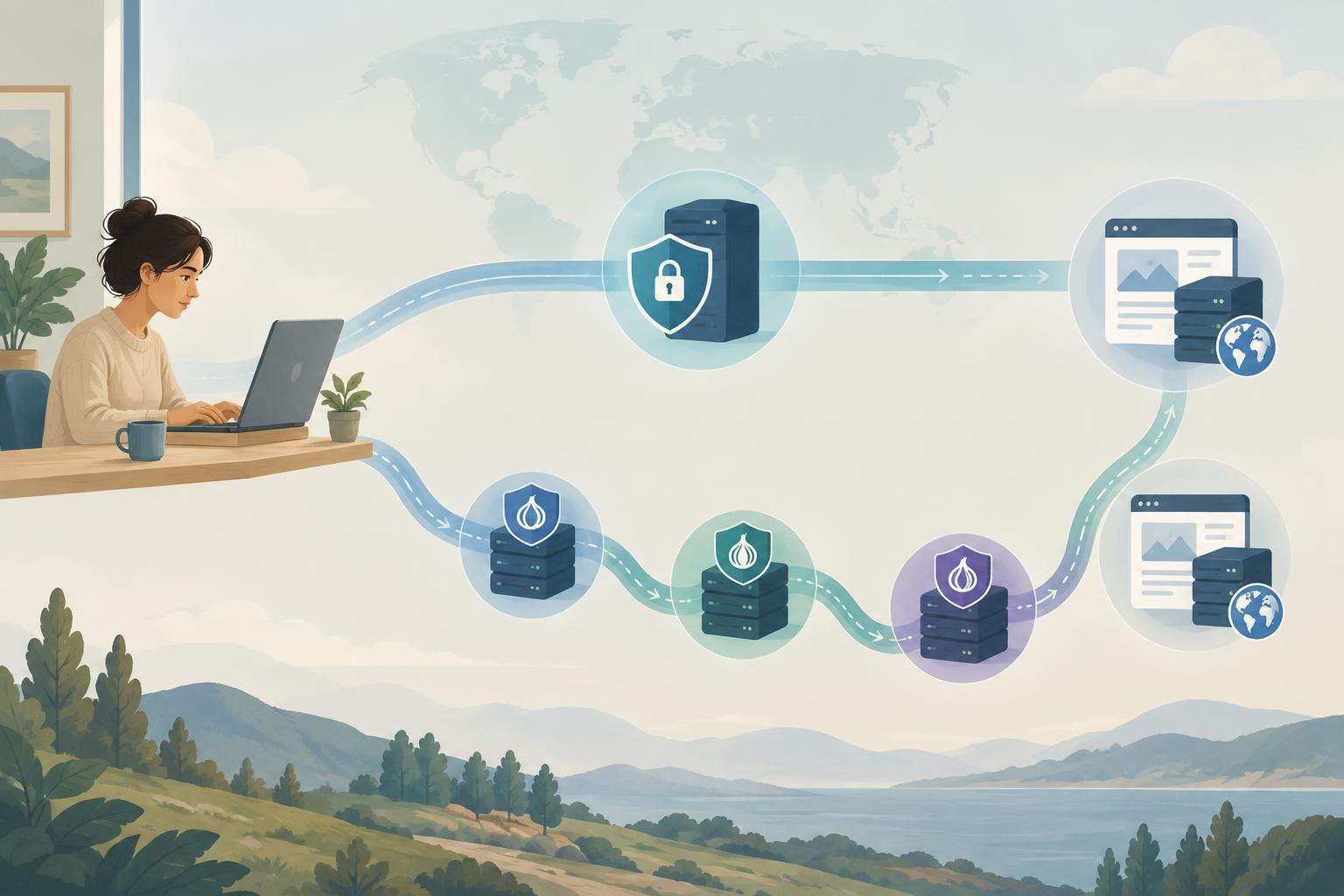
Start with the question: private from whom?
“Online privacy” can mean several things. You might want to keep a website from seeing your home IP address, prevent a local network operator from seeing which sites you visit, or make it harder to connect browsing activity to your identity. A VPN and Tor can help with some of these goals, but neither solves all of them.
It helps to picture a simple connection: your device sends traffic through your internet provider and onward to a website. Along the way, different parties can observe different details. HTTPS encrypts the content exchanged with a compatible website, but it does not, by itself, hide your IP address from that website. A VPN or Tor changes the route your traffic takes; it does not make every action you take online private.
What a VPN changes
A virtual private network creates an encrypted connection between your device and a VPN provider’s server. To a website, a properly configured connection generally appears to come from that server rather than your home network. Your internet provider can see that you are connecting to a VPN, but it generally cannot see the destinations inside the encrypted VPN tunnel. The VPN provider, in turn, is in a position to observe connection information and may be able to see destinations, depending on how traffic and DNS requests are handled.
That trade-off makes trust central to VPN use. A provider’s claims about logging are not the same as a technical guarantee that it cannot observe traffic. Device settings also matter: traffic may bypass the tunnel if an app is excluded, the VPN disconnects without protective settings, or DNS is configured outside it. Testing the setup and understanding its limits are more useful than assuming that switching a VPN on makes all device activity private.
A VPN can be a practical choice when you want to reduce what a local network can learn about your browsing or avoid sharing your home IP address with the sites you visit. It does not prevent those sites from recognizing you through a login, cookies, or other identifiers.
What Tor changes
Tor routes traffic through a sequence of volunteer-operated relays rather than a single provider’s server. In a typical Tor connection, the entry relay can see your IP address but not the final website, while the exit relay can see the destination but not your original IP address. The website sees the exit relay’s IP address. This separation is intended to make it harder for any one relay to link who you are with where you go.
Tor Browser is designed to use that network while reducing common ways a browser can stand out. Using it as provided is generally safer than adding extensions or changing settings without a clear reason: customizations can make your browser more distinctive or create unexpected leaks. Tor may also feel slower than a direct connection, and some sites challenge or block traffic from exit relays.
Tor is not a promise of anonymity. An exit relay may be able to observe traffic that is not protected by HTTPS, and signing in to a personal account tells that service who you are regardless of the route you took. Powerful observers with visibility into multiple parts of a connection may present additional risks. Tor is most useful when you need stronger separation between your IP address and your destination and can accept its usability trade-offs.
Choose by task, not by label
For ordinary browsing on a network you do not control, a reputable VPN can provide a convenient encrypted path to its server. If your main concern is avoiding reliance on one VPN provider to separate your identity from the sites you visit, Tor offers a different design. Neither choice removes the need to check that you are using the intended website, keep your software updated, and use HTTPS where available.
Using a VPN and Tor together is possible, but stacking them does not automatically deliver the best of both. It changes which party can see your connection to Tor, while adding configuration choices and another service to trust. First decide what you are trying to hide and from whom; then consider whether the extra complexity addresses that specific concern.
Finally, keep routing separate from identity. A changed IP address does not erase an account login, a reused email address, or information you voluntarily share. For many people, sensible account practices and an understanding of what websites collect will do as much for day-to-day privacy as choosing between these two tools.