Start with the intended receivers
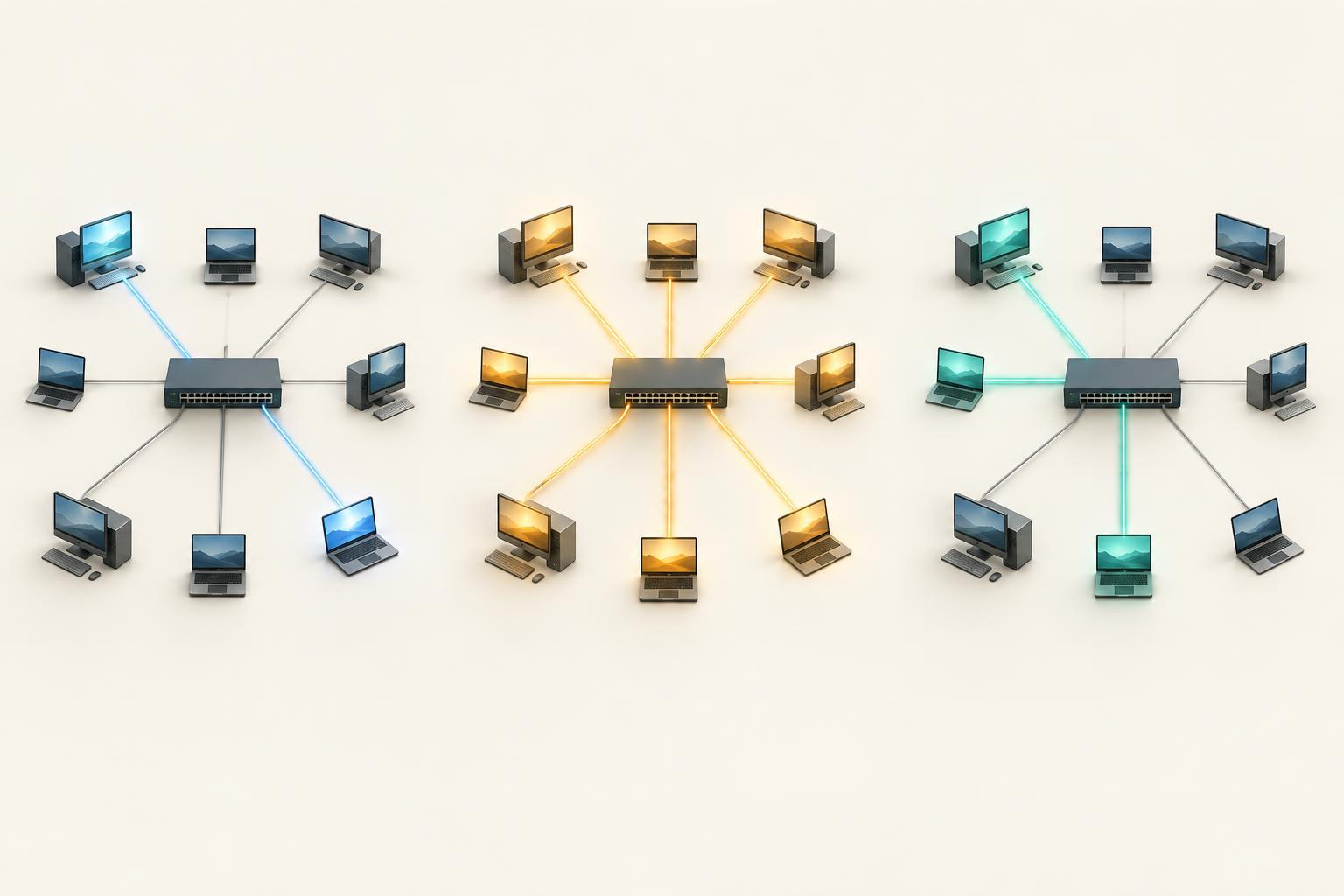
Every network packet has a destination, but that destination does not always mean one device. Unicast is one-to-one delivery: a sender addresses a particular receiver. Broadcast is one-to-all delivery within a local broadcast domain. Multicast is one-to-many delivery for receivers that have joined a particular group. These terms describe who the traffic is meant to reach, not whether the application is fast, reliable or secure.
Picture a small office with twenty computers. Sending a file to one computer is a unicast task. Asking every device on the local network for information can involve broadcast. Sending the same live training stream to ten computers could use multicast, if the network and application support it. The distinction matters because each pattern places a different amount of work on senders, receivers and network equipment.
Unicast: one destination at a time
Most familiar network interactions use unicast. When a laptop requests a web page, it exchanges packets with a specific server address. Replies are addressed back to the laptop. Routers can forward unicast packets toward their destinations using ordinary routing information, making this pattern suitable for communication across networks.
Unicast also allows each receiver to have a separate conversation. A server can send different content to different clients, and an application can track each connection independently. The trade-off appears when many people need identical data: sending a separate copy to each receiver can increase the sender’s outbound traffic. For a modest audience, that simplicity may still be preferable to deploying multicast.
One-to-one addressing does not itself guarantee delivery. Reliability depends on the transport protocol and application design. For example, TCP includes mechanisms for acknowledging and retransmitting data; a unicast packet sent over UDP does not gain those properties merely because it has one destination.
Broadcast: everyone on the local segment
In an IPv4 local network, a broadcast packet is intended for all devices in a broadcast domain. An Ethernet switch generally forwards a broadcast frame out its other ports in that domain, so devices receive it even if most have no use for it. Routers normally separate broadcast domains rather than forwarding local broadcasts across the wider internet.
Broadcast is useful when a device does not yet know exactly whom to contact. Address Resolution Protocol (ARP), for instance, can use a local broadcast to ask which device owns a particular IPv4 address. Broadcast makes discovery straightforward, but it asks every receiving device to inspect the traffic. Excessive broadcasts can waste bandwidth and processing capacity, which is one reason networks are divided into smaller segments.
Do not assume every network has the same broadcast behavior. IPv6 does not use broadcast addresses; it uses multicast for tasks such as local neighbor discovery. Even with IPv4, network boundaries and device settings affect how far a broadcast reaches.
Multicast: a group of interested receivers
Multicast addresses a group rather than an individual device or every device nearby. A sender transmits traffic to a multicast group address, and receivers join that group when they want the data. This can suit a live feed delivered to many viewers: instead of sending one full stream per viewer, the network can replicate traffic where paths toward receivers diverge.
That efficiency depends on the network. Hosts can signal group membership using protocols such as IGMP for IPv4 or MLD for IPv6. On a local network, a switch with multicast snooping can use membership information to limit which ports receive group traffic. Reaching receivers across routed networks requires appropriate multicast routing support; multicast does not simply travel everywhere that unicast can.
Multicast also does not provide reliable delivery or access control by itself. An application that needs to recover missing packets, control who may view content or adapt quality for each viewer must provide those capabilities separately. When multicast support is unavailable, applications often distribute the same content through multiple unicast connections instead.
Choose the pattern that matches the job
Use unicast when communicating with a known destination, especially when each receiver needs a distinct response. Use broadcast sparingly for local tasks that genuinely need to reach an entire IPv4 broadcast domain. Consider multicast when many receivers need the same data at roughly the same time and you can manage the required network support.
A quick way to reason about a design is to ask three questions: Who needs this packet? How far must it travel? What must happen if a receiver misses it? Those answers help separate the delivery pattern from other requirements. Unicast, broadcast and multicast determine the intended audience; protocols and applications determine much of what happens next.