The same steps, in a different order
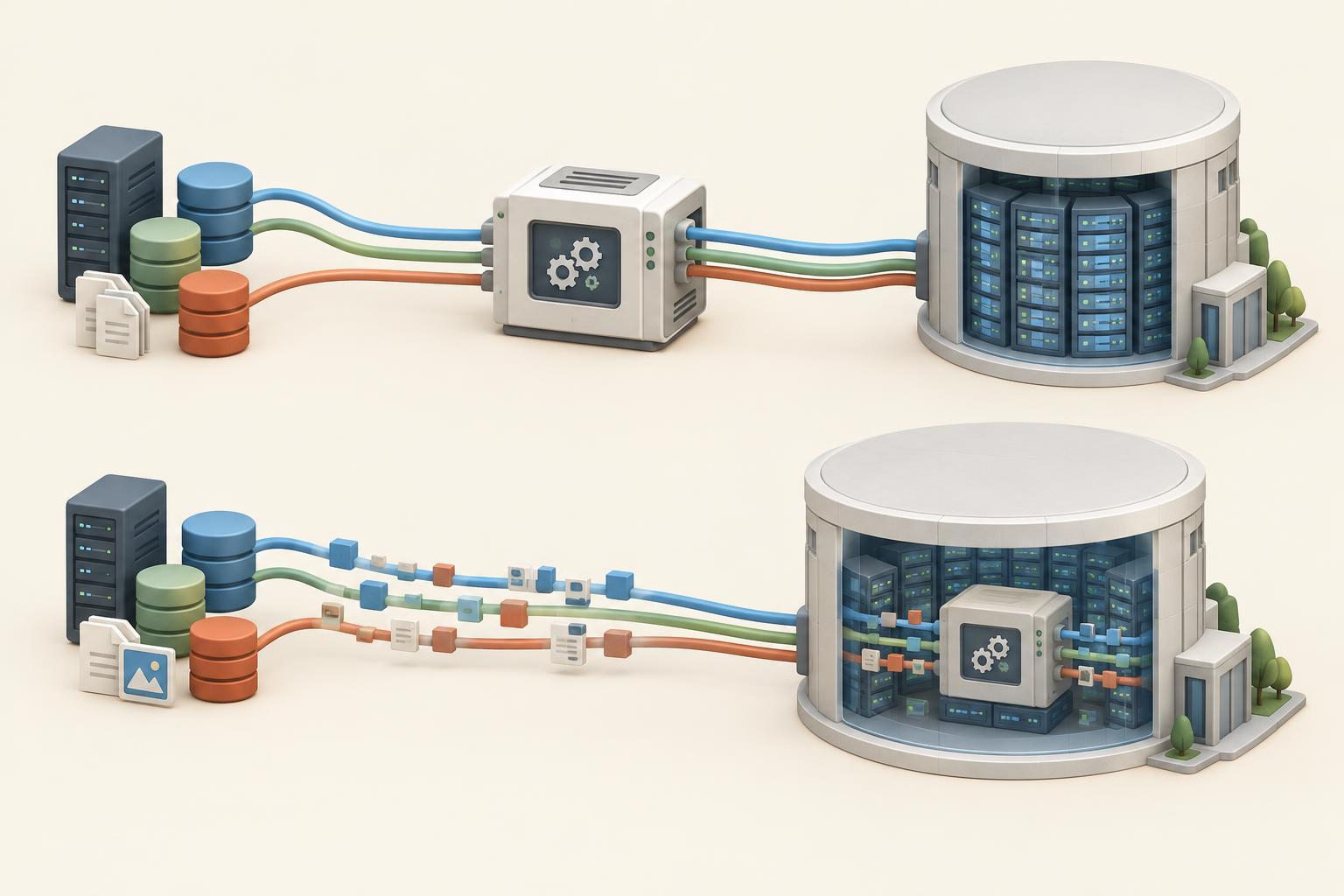
A data pipeline often has three jobs: extract records from a source, transform them into a usable form, and load them into a destination. Sources might include an application database, a billing system, or files exported by another team. The destination might be a reporting database or a data warehouse. ETL stands for extract, transform, load. ELT stands for extract, load, transform. The letters describe the order of the main steps, not a particular product.
In ETL, transformation happens before data reaches its primary analytical destination. A separate process might join records, standardize field names, and reject invalid rows, then load the prepared result. In ELT, the pipeline first loads extracted data into the destination, often into a staging area. Transformations then run there to create tables for analysis. Both patterns can produce the same final report; their differences become clearer when you look at where work runs and what data is retained.
Following an order through each pipeline
Imagine a small shop that wants to report daily sales. Its application stores orders, while a separate system stores product details. To calculate sales by product category, the team needs to combine those records, convert timestamps to a consistent format, and decide how to handle cancelled orders.
With ETL, a processing job could extract both datasets, make those changes outside the reporting database, and load a finished daily sales table. The destination receives data shaped for that report. With ELT, the job could load the extracted orders and product records first. Queries or transformation jobs in the destination would then build the daily sales table. Keeping the loaded inputs may let the team revise its cancellation rule later and rebuild the result without extracting everything again, provided the necessary records were retained.
Neither pattern removes the need to define the calculation. The team still has to decide which timestamp marks a sale, how to match products to orders, and what happens when a record is missing. ETL and ELT determine where those rules are applied, not what the rules should be.
Why the location of transformation matters
ETL can be useful when data must be cleaned or reduced before it enters the destination. For example, a pipeline may need to remove fields the reporting system has no reason to store. Transforming upstream can also fit a destination with limited processing capacity. The trade-off is that changes to transformation rules may require another extraction, especially if the original inputs were not retained elsewhere.
ELT takes advantage of a destination that can store substantial input data and run transformation jobs. Loading first can make it easier to create several outputs from the same inputs: one table for sales trends and another for inventory analysis. It can also simplify some revisions because the team can rerun a transformation against retained data. Those benefits come with responsibilities. Staging tables use storage, transformations consume compute, and loaded data needs access controls and retention rules.
The distinction is not absolute. An ELT pipeline may check formats or remove sensitive fields before loading. An ETL pipeline may keep source snapshots for later use. Describing a pipeline accurately is more helpful than forcing every step into one label.
Choosing a pattern for a small team
Start with the destination and the data. If the destination supports efficient queries and the team expects to reuse source records for several analyses, loading into a controlled staging area and transforming there may be practical. If the destination is meant to hold only a narrow, prepared dataset, or if certain fields should never enter it, transforming before the load may be a better fit.
Next, consider how the pipeline will be operated. Identify where a failed step can be restarted, how duplicate loads will be detected, and how changes to a source schema will be noticed. Give staging tables names and permissions that distinguish them from reviewed reporting tables. Document the transformation rules so someone reading a metric can trace it back to its inputs. These habits matter with either ETL or ELT.
A useful first design is often modest: select one source, define one destination table, and test how the pipeline handles missing values, repeat runs, and a changed field. Measure storage use and job duration in your own environment before adding complexity. The aim is not to pick the more fashionable acronym. It is to put transformation where the team can run, inspect, and maintain it reliably.