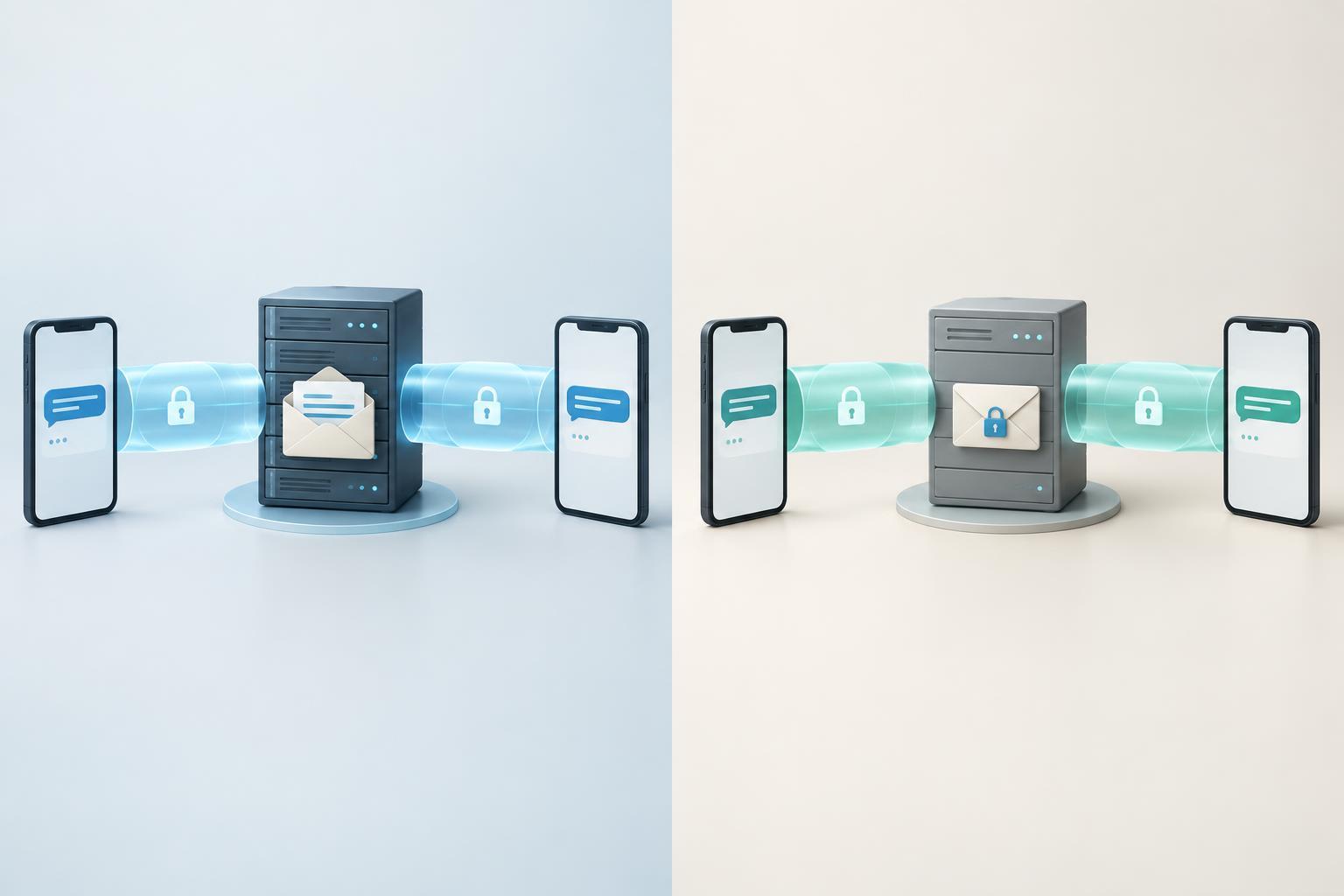
The difference is where messages become readable
Imagine sending a message from your phone to a friend. It may pass through your internet provider, a messaging service and your friend’s network before appearing on their screen. Encryption makes the message unreadable to parties that do not have the right key. The central question is where, along that path, the message is decrypted.
With transport encryption, your app establishes an encrypted connection to the messaging service. The service can decrypt data at its server, process it and establish a separate encrypted connection to the recipient. This protects the message from someone merely observing either network connection, but the service can access the message content at the point between them.
With end-to-end encryption, the sender’s device encrypts the message so that only the intended recipient’s device, or devices, can decrypt it. The service still delivers the message, but its servers should not need the keys that reveal its content. A useful shorthand is that transport encryption protects the journey to a server, while end-to-end encryption protects the message across the server.
What transport encryption does well
Transport encryption is valuable. When implemented correctly, it helps prevent people on a shared Wi-Fi network or another part of the network path from reading or changing messages in transit. It also lets an app check that it is connecting to the expected service rather than an impostor. Many messaging systems use transport encryption even when they also use end-to-end encryption.
Because a service can read messages protected only by transport encryption, it may be able to provide features such as server-side search, content filtering or recovery of message history after you sign in on a new device. That access also creates a trust boundary: the provider’s systems and access controls become part of what protects message content. Transport encryption alone does not keep a compromised service, or someone with authorized access to its readable data, from seeing it.
An encrypted connection therefore does not, by itself, answer whether a message is private from the service carrying it. A lock symbol or a statement that an app uses encryption may describe transport protection without describing what happens on the server.
What end-to-end encryption changes
End-to-end encryption moves the content keys to participants’ devices. In a one-to-one conversation, the sender’s app encrypts a message for the recipient, and the recipient’s app decrypts it. Group chats and conversations with multiple devices need additional key management so each authorized device can read the messages intended for it. The exact design varies by service.
This approach limits what a provider can learn from message contents while delivering them. It does not make a device itself safe: someone who unlocks a participant’s phone, compromises its software or sees a screenshot may still read the conversation. Nor does it guarantee that every related feature is covered. Cloud backups, notification previews, linked devices and messages sent to external services may have different protections.
End-to-end encryption also depends on knowing which devices hold the recipient’s keys. If an attacker can successfully substitute a device or key, encryption may protect a message on its way to the wrong endpoint. Some apps offer contact verification or alerts when a contact’s security information changes. Those tools are most useful when participants check them through a trusted channel, especially for sensitive conversations.
Content privacy is not the same as complete anonymity
Even when message text and attachments are end-to-end encrypted, a service may need information to route and operate a conversation. Depending on the system, it may know account identifiers, which accounts communicate, delivery times, device information or approximate message sizes. This surrounding information is often called metadata. The amount retained or exposed depends on the service’s design and settings, not on the label “end-to-end encrypted” alone.
Other traces may remain outside the messaging system. A recipient can save or forward content, and an operating system may show part of a message on a lock screen. If either participant uses an unprotected backup, copies of the conversation may be accessible there. Encryption protects a defined path and set of data; it is not a promise that no copy can ever be seen.
How to assess a messaging app
Start with the specific conversation you plan to use. Check whether end-to-end encryption is on by default or must be enabled, and whether it covers group chats, attachments and calls as well as one-to-one text. Look at what happens when you add a device or restore a backup: can the provider recover readable message history, or is recovery protected by a key or secret only you control? Product descriptions may not answer every question, so distinguish an explicit feature from an assumption.
For everyday use, keep devices updated, use a strong device lock and review connected devices and backup settings. Where an app offers contact verification, consider using it for conversations in which an unexpected key change would matter. These steps address risks that encryption alone cannot remove.
The practical distinction is a matter of trust boundaries. Transport encryption keeps outsiders on the network path from reading a message, while still allowing the service to handle its readable contents. End-to-end encryption aims to keep those contents readable only on participants’ devices. Understanding that boundary makes it easier to choose a tool—and to recognize the protections it does not provide.